

SERVICE: IDENTITY AND ACCESS MANAGEMENT / NAVIGATE IAM
Managed IAM for higher education, built on open-source components
Unicon helps Higher Education institutions move from scattered access controls and manual provisioning to fully-managed identity systems that hold up under real operational and audit pressure.

IAM needs to work the way you and your community work
Identity sits at the center of every system an institution runs. Students, faculty, staff, contractors, and partners all move through applications with different roles, timelines, and access needs. When identity is inconsistent, the impact shows up quickly in access issues, audit findings, and support burden.
Most institutions don’t have the internal capacity to design, implement, and operate IAM at scale. The work spans governance, lifecycle management, integrations, and ongoing operations, and gaps in any of those areas create risk.
IAM needs to support how you actually operate
Identity issues tend to show up across multiple systems at once. These challenges affect security, user experience, and day-to-day operations.
Provisioning and deprovisioning are manual or inconsistent across departments
MFA, federated access, and group management vary by system
Audit requests require manual effort to document access and controls
Identity lifecycle is not aligned across student, faculty, staff, and contractor populations
IAM knowledge is concentrated in a small number of people
Campus logins that work across every identity environment
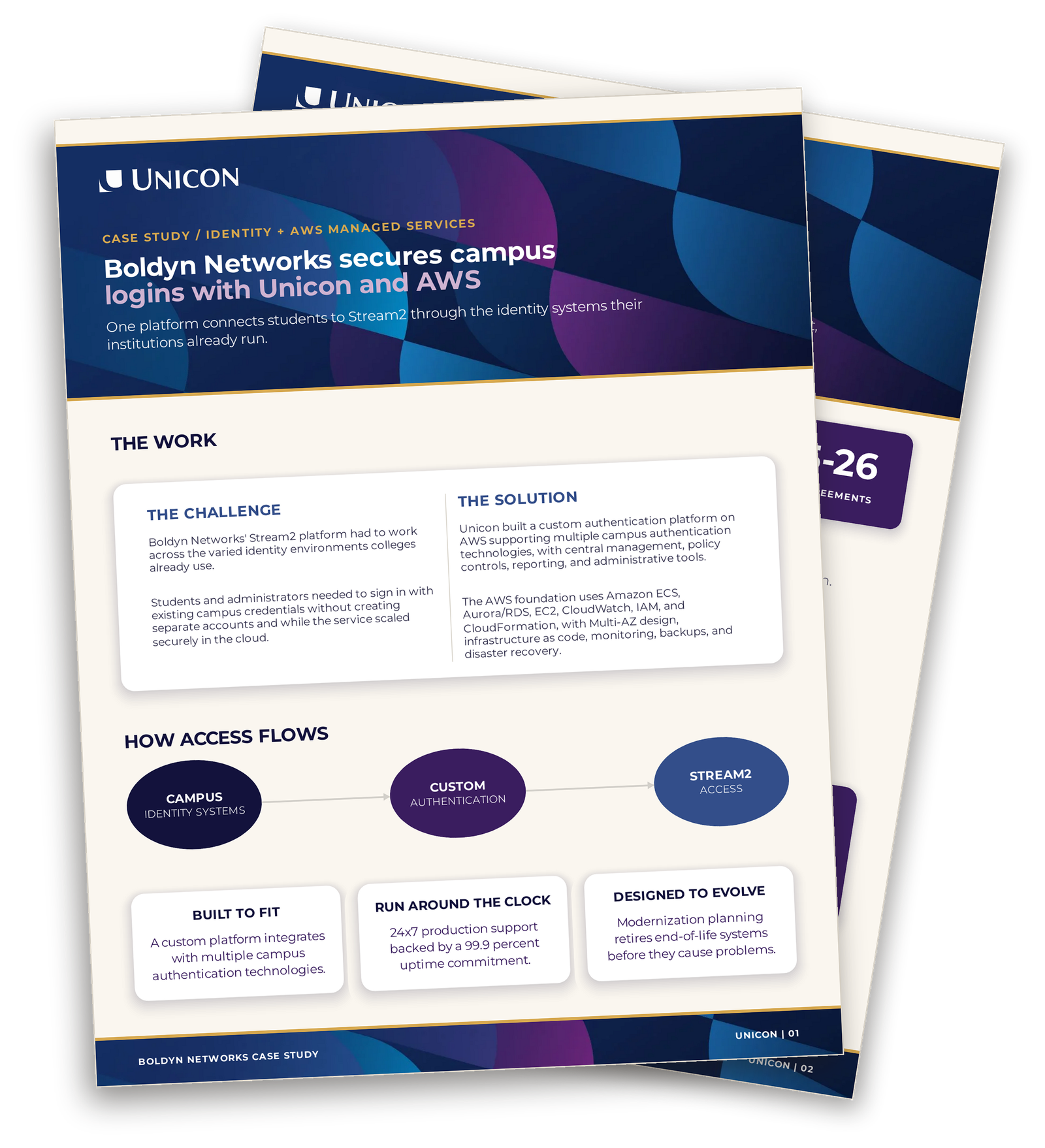
Unicon designed and built a custom authentication platform so students and administrators can reach Boldyn's Stream2 service with their existing campus credentials. What started as a build became a multi-year AWS Managed Services and identity partnership.

Get fully-managed IAM from the teams who help build it
Managed IAM platform (Navigate)
Running IAM at scale requires more than standing up software. It involves continuous operations, upgrades, monitoring, and coordination across systems that are always changing. Many institutions reach a point where the platform exists, but the operational model does not.
Over time, that gap shows up in delayed access requests, inconsistent provisioning, growing support queues, and difficulty keeping up with security and audit expectations. Even well-designed IAM systems degrade without sustained attention and expertise.
Unicon provides a fully managed IAM platform through Navigate, handling infrastructure, operations, upgrades, and ongoing support so institutions can rely on a system that stays stable and current.
IAM evaluation and roadmap
Institutions often know identity needs attention, but the starting point is not clear. Problems show up across provisioning, governance, policy, and integration, and it is difficult to prioritize what to address first.
Without a structured assessment, teams either move too slowly or take on changes that create new issues elsewhere. A clear view of current-state gaps and dependencies is needed before making platform or staffing decisions.
Unicon conducts IAM evaluations that assess governance, lifecycle management, access controls, and integrations, then delivers a phased roadmap that gives institutions a practical path forward.
Open-source IAM architecture
IAM decisions have long-term consequences. Platform choices affect how identity integrates with applications, how access is governed, and how much flexibility the institution has over time. Many environments evolve into a mix of tools that are difficult to extend or align.
A composable architecture built on standards allows institutions to adapt without starting over. It also reduces dependence on proprietary systems that can limit control or introduce unnecessary complexity.
Unicon designs IAM architectures using open-source components like CAS, Shibboleth, Grouper, and midPoint, creating systems that are flexible, standards-based, and aligned to institutional needs.
Implementation and engineering
IAM implementations span multiple systems and require coordination across identity providers, applications, and data sources. Each integration introduces new dependencies, and small gaps can create issues that affect users across the environment.
These projects require both technical depth and experience working within institutional constraints. Decisions made during implementation affect how the system performs, scales, and integrates over time.
Unicon delivers IAM implementation and engineering services across installation, configuration, integration, federation, and governance, drawing on experience across higher education environments.
Managed services and ongoing support
IAM is not a one-time, set-and-forget project. Systems need ongoing updates, monitoring, and support to remain effective as users, applications, and requirements change.
Without a clear support model, institutions face growing backlogs, delayed responses, and increased risk as systems fall out of sync with current needs.
Unicon provides ongoing IAM support with structured response models, direct access to subject matter experts, and optional 24x7 coverage for production environments.

What you need to know
Unicon focuses on building integration architectures that are documented, standards-based, and use industry best practices.
Navigate IAM can stand alone to fix specific identity challenges or support larger efforts like modernization, consolidation, or education-to-workforce initiatives.
|
30 days |
Clear view of current-state IAM gaps across provisioning, access control, governance, and integrations. Defined priorities, initial architecture direction, and a roadmap aligned to institutional constraints. |
|
90 days |
Core identity components in progress, including provisioning flows, access models, and integration patterns. Governance decisions, lifecycle definitions, and audit considerations documented and ready for stakeholder review. |
|
6 months |
Identity system operating across key populations and applications with consistent provisioning and access controls. Support model, monitoring, and a prioritized backlog in place to maintain and improve the system over time. |
20+ states
Experience implementing Ed-Fi and large-scale interoperability across districts and statewide systems
End-to-end coverage
Work spans K-12, higher education, and workforce data exchange within a single team
Vendor-neutral approach
Integration architectures built on published standards, not tied to a single platform
For Higher Ed institutions of all sizes
For large universities: identity spans multiple systems and populations, with audit and security expectations continuing to increase. A managed platform and clear governance model reduce operational risk and improve consistency.
For mid-sized institutions: IAM capabilities often depend on a small team. Additional support and structured implementation reduce single points of failure and improve response times.
For consortia and shared environments: multiple institutions rely on federated identity and shared access models. Strong architecture and ongoing support help maintain reliability across partners.
What Navigate IAM enables
Consistent identity lifecycle management across populations
Reduced manual work for provisioning and access control
Improved audit readiness and documentation
More reliable integration across systems and applications
Reduced operational burden on internal teams
Higher education is different. Your IAM platform should be too.
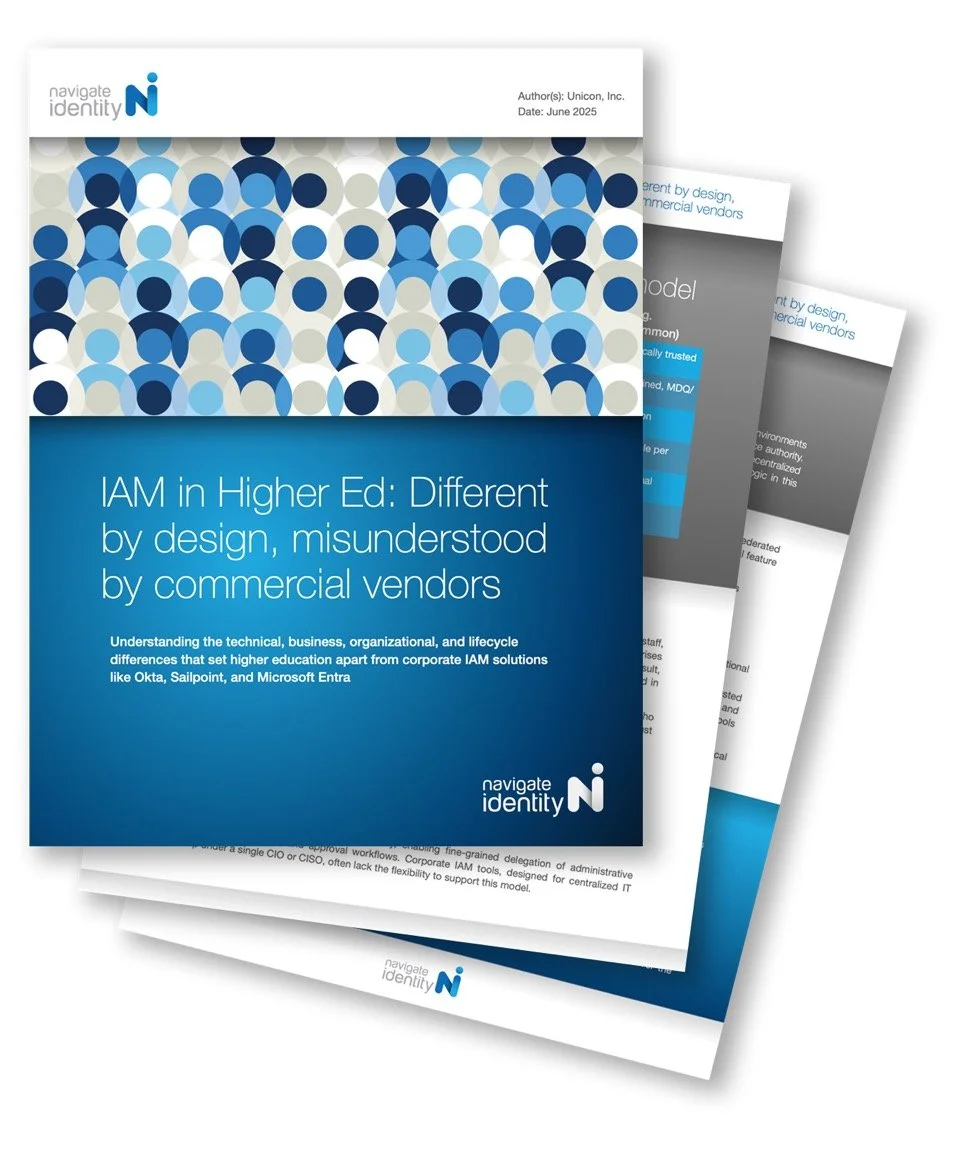
Identity in higher education is not a corporate problem with a corporate solution. Students become TAs mid-semester. Faculty hold appointments in three departments. Researchers come and go. This guide walks through how Navigate IAM handles the real complexity of higher education identity without forcing institutions into an enterprise mold.
Inside: comparative IAM frameworks, architecture guidance, provisioning and deprovisioning examples, open standards coverage including SAML, SCIM, and LDAP, InCommon and eduGAIN federation support, and a practical evaluation checklist for IAM platform decisions.

Identity at scale
Managed IAM platform
Hosted identity system with infrastructure, operations, and support included
Open-source, standards-based architecture
Flexible systems built on CAS, Shibboleth, Grouper, and midPoint
Long-term operational support
Ongoing expertise for environments that need to remain stable and secure
Start a Conversation
Ask a question, request a case study, book a consultation, or request a demo.