

PROGRAM: EDUCATION-TO-WORKFORCE INFRASTRUCTURE
Build the infrastructure your skills programs need to scale
Unicon helps institutions, states, and partners build the infrastructure that allows skills data to move, so data can actually connect education to employment…

Skills data is trapped
Students complete programs, earn credentials, and build experience, but that data stays locked inside LMS platforms, SIS systems, credential tools, and employer systems that do not talk to each other.
The issue is not content or collaboration, but about infrastructure.
Skills data is spread across LMS, SIS, credential systems, and employer platforms with no reliable way to connect them.
Programs look aligned on paper, but learner records do not follow students across institutions or into the workforce.
Each system defines skills differently, so data loses meaning when it moves.
Integrations are custom and fragile, which makes scaling across districts, states, or employer networks difficult.
Most efforts work as pilots, but break down when asked to operate at scale.

What we help you build
1. Map the full ecosystem
Start with a clear view of how learners, systems, and data connect today.
Unicon maps stakeholders, platforms, data sources, and credential flows across the full pipeline from K-12 through higher education and into workforce systems.
Outcome: Clarity on where data breaks, where friction exists, and what must be fixed first
3. Build the layer that moves data
This is the missing piece in most efforts.
Unicon designs and implements interoperability infrastructure that allows learner records, credentials, and skills data to move between systems, including LMS, SIS, wallets, state data systems, and employer platforms.
This includes standards, governance boundaries, and the data flows needed for real-world use.
Outcome: Skills data that can move where it needs to go, when it needs to go
2. Define what “skills” actually mean
Skills only work if everyone agrees on what they are.
Unicon helps define taxonomies, assessment approaches, and credential models aligned to employer demand. This creates shared meaning across institutions, programs, and employers.
Outcome: Consistent, usable skills data that can travel across systems without losing meaning
4. Deliver a working system, not a pilot
Programs fail when delivery is fragmented.
Unicon coordinates implementation across institutions, vendors, and stakeholders. This can include deploying platforms like Open edX with skills capabilities, connecting to wallets and registries, and ensuring the system is usable from day one.
Outcome: A system that works across organizations, not just within one
5. Measure outcomes across the full pathway
If you cannot track outcomes, the program will not last.
Unicon builds the data layer needed to measure progression from learning to skills to employment. This supports reporting to funders, agencies, and employers while improving how programs operate over time.
Outcome: Visible outcomes, stronger reporting, and a credible path to scale
What progress looks like
If skills data cannot move, nothing else works.
Students cannot carry their records forward. Institutions cannot see outcomes. Employers cannot trust signals. Programs remain isolated.
When skills data moves, the system starts to function:
Learners carry verified records with them
Institutions connect programs to outcomes
Employers gain usable signals for hiring and development
Ecosystems move from pilots to real infrastructure
|
30 days |
You have a clear map of the ecosystem, aligned stakeholders, and a defined plan for how skills data will move across systems. |
|
90 days |
Skills architecture is defined, integration points are clear, and the first phase is ready to execute with governance in place. |
|
6 months |
The first phase is live, skills data is moving across systems, and early outcomes are measurable with a path to broader adoption. |

Cross-system expertise
Unicon works across K-12, higher education, EdTech, and workforce systems, not just within one layer of the ecosystem
Infrastructure-first approach
The focus is on data movement and interoperability, not just launching another platform
Proven at scale
Unicon has supported statewide data integration efforts and multi-institution programs that require coordination across systems
Connecting skills data across a statewide system
A state education agency needed to connect K-12 and higher education data and make it usable for students, districts, and institutions.
The challenge was not a lack of data. It was that systems were disconnected, and there was no reliable way to move information across them in a consistent, usable format.
Unicon built applications on top of a statewide data exchange, embedding interoperability, governance, and outcomes measurement into the system from the start.
The result was a set of production systems used across the state, with outcomes data connected across K-12 and higher education for the first time.
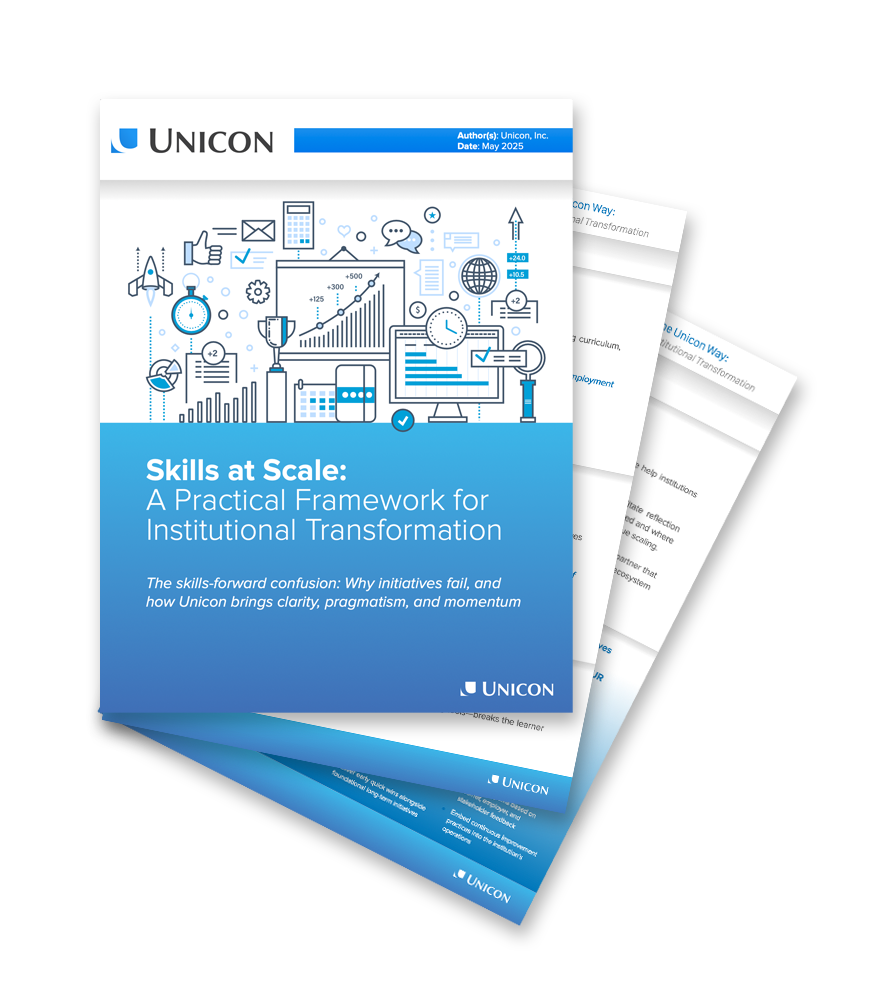
Skills at Scale: A Practical Framework for Institutional Transformation
Most skills-forward initiatives fail not because of weak vision but because no one maps the path from strategy to execution. This guide covers Unicon's four-phase framework for building skills-first programs that hold up technically, culturally, and organizationally.
Inside: readiness assessment, labor market alignment, LMS/SIS/wallet integration guidance, and case examples from higher education, edtech, and workforce programs.

Core Services
Start a Conversation
Ask a question, request a case study, book a consultation, or request a demo.