

SERVICE: DATA STRATEGY AND GOVERNANCE
From “data that exists” to data that gets used
Most education organizations already have the data they need.
Unicon helps institutions move from scattered data and inconsistent reporting to systems where people can rely on the numbers in front of them and act on them.

Where data strategy & governance break down
Many education organizations have accumulated significant data across disconnected systems.
Reporting exists, but quality and freshness vary by source. Governance initiatives lead to committees and documentation, but don’t change how data actually flows or builds trust.
Unicon takes a bottom-up approach, starting with a specific data asset stakeholders depend on, governing it, and building from there.
Teams describe their situation as data-rich but information-poor: substantial data exists, but few reliable answers to operational questions
Conflicting numbers across reports lead stakeholders to build their own spreadsheets rather than rely on shared systems
Governance initiatives produce documentation and committees but limited change to how data flows or is trusted
Leadership is under pressure to demonstrate AI readiness before the underlying data quality and access foundations are in place
Siloed systems make analytics a manual, time-intensive process that cannot keep pace with decision-making needs

Data strategy delivery
Get a clear view of your data environment
Start with what actually exists, not what should exist.
Unicon assesses your systems, datasets, integrations, and reporting workflows. The result is a clear view of which data is trusted, where gaps exist, and what to fix first.
Outcome: A practical roadmap tied to real decisions, not a theoretical strategy
Deliver reporting people believe
Dashboards are only useful if people trust the numbers.
Unicon builds reporting alongside data lineage and source attribution, so stakeholders know where the data comes from and why it is reliable.
Outcome: Fewer debates about the numbers and faster decision-making
Make governance real
Governance only works when it changes how data is used.
Unicon implements governance around a specific, high-value dataset that stakeholders depend on. Policies, ownership, and definitions are put into practice, then expanded from there.
Outcome: Shared definitions, clear ownership, and data people can actually trust
Build a data foundation that holds up
Disconnected systems create ongoing maintenance work and inconsistent outputs.
Unicon integrates data from core systems and external sources into a structured environment designed for reliability and scale. This includes support for education standards like Ed-Fi where needed.
Outcome: Less manual work, more consistent data, and a foundation that supports future initiatives
Support ongoing data operations
Data work does not stop after initial delivery.
Unicon provides ongoing support for pipeline maintenance, governance operations, and analytics iteration, so your team can focus on using data instead of fixing it.
Outcome: Sustained progress without constant rework

“NEED TO UPDATE THIS QUOTE. Unicon helps institutions move from debating whose numbers are right to operating from shared, trusted information.”
|
30 days |
You have a clear understanding of your data ecosystem, including what is trusted, what is not, and where to focus first. |
|
90 days |
Governance is in place for key datasets, reporting is more consistent, and manual data work is starting to decrease. |
|
6 months |
You have a stable data foundation, trusted reporting, and a team spending more time on analysis than data preparation. |

40 to 60%
Reduction in manual reporting workload following data pipeline and semantic layer engagements. Institutional research teams shift from data preparation to analysis.
20+ states
Ed-Fi data standard implementations supported by Unicon, including multi-district and statewide interoperability programs.
30 to 50%
Faster path to a trusted, scalable data foundation based on higher education client engagements.
What changes with Unicon
Reporting becomes consistent across systems
Manual data preparation is reduced
Stakeholders trust shared dashboards instead of building their own
Data flows are documented and easier to maintain
The organization is better prepared for AI and advanced analytics
From conflicting reports to shared data
A large research university was spending significant time reconciling reports across systems. Different teams produced different numbers, and institutional research staff were focused more on data preparation than analysis.
Unicon implemented data pipelines and a semantic layer that aligned definitions and sources across systems. Reporting became more consistent, and the time spent preparing data dropped significantly.
The result was a shift in how the team worked. Instead of debating which numbers were correct, they were able to focus on interpreting results and supporting decision-making.
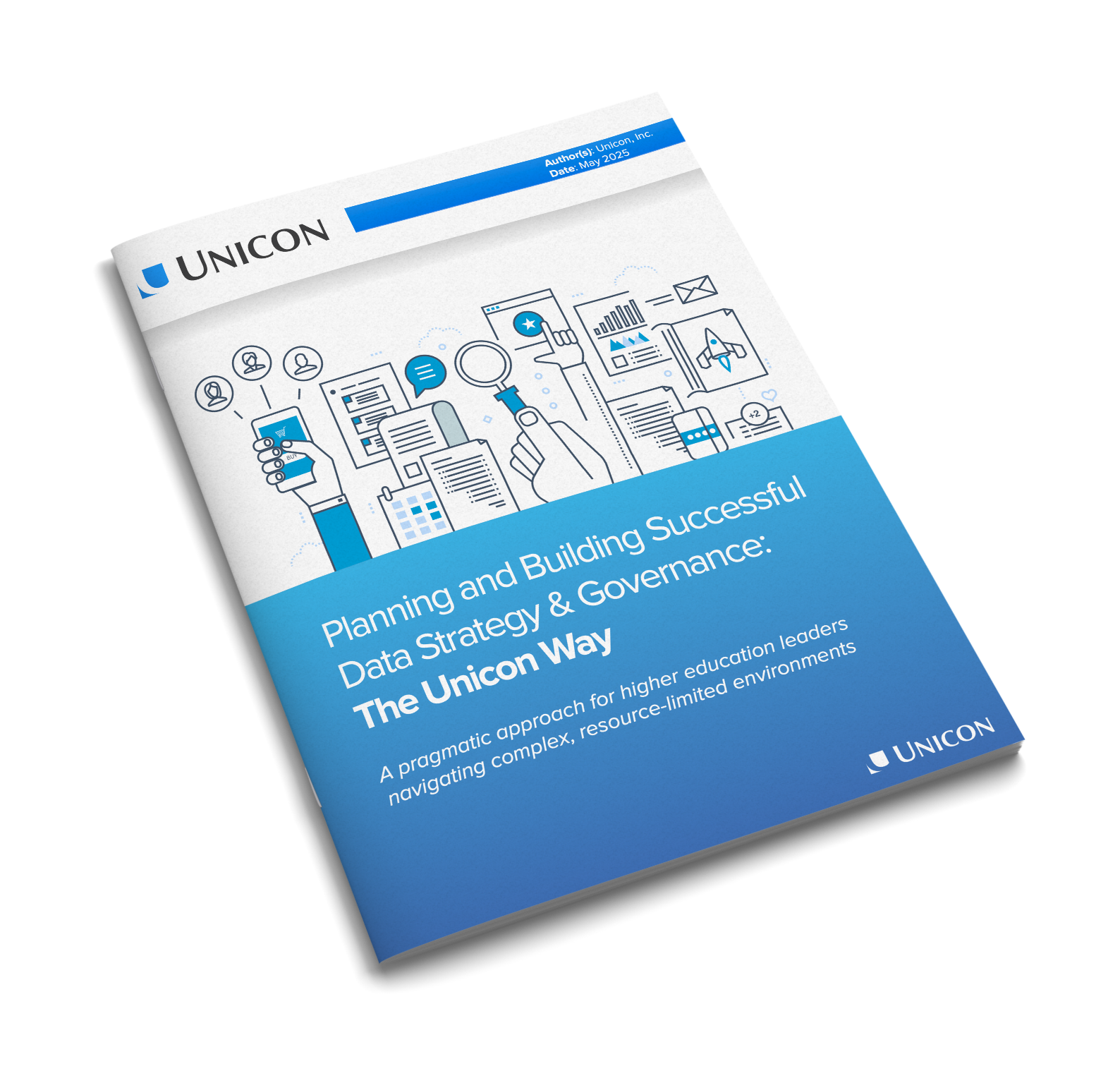
Getting Started with Data Governance in Higher Education
Governance feels overwhelming because most frameworks are designed for enterprises, not institutions. This guide walks through Unicon's bottom-up approach with practical steps to launch or refine a governance program that fits your culture, your team, and your data.
Inside: a step-by-step framework, maturity assessment approach, role and policy definitions, and real-world examples from higher education implementations.

Core Services
Start a Conversation
Ask a question, request a case study, book a consultation, or request a demo.