How AI is Forcing a Shift to Skills-Based Credentialing
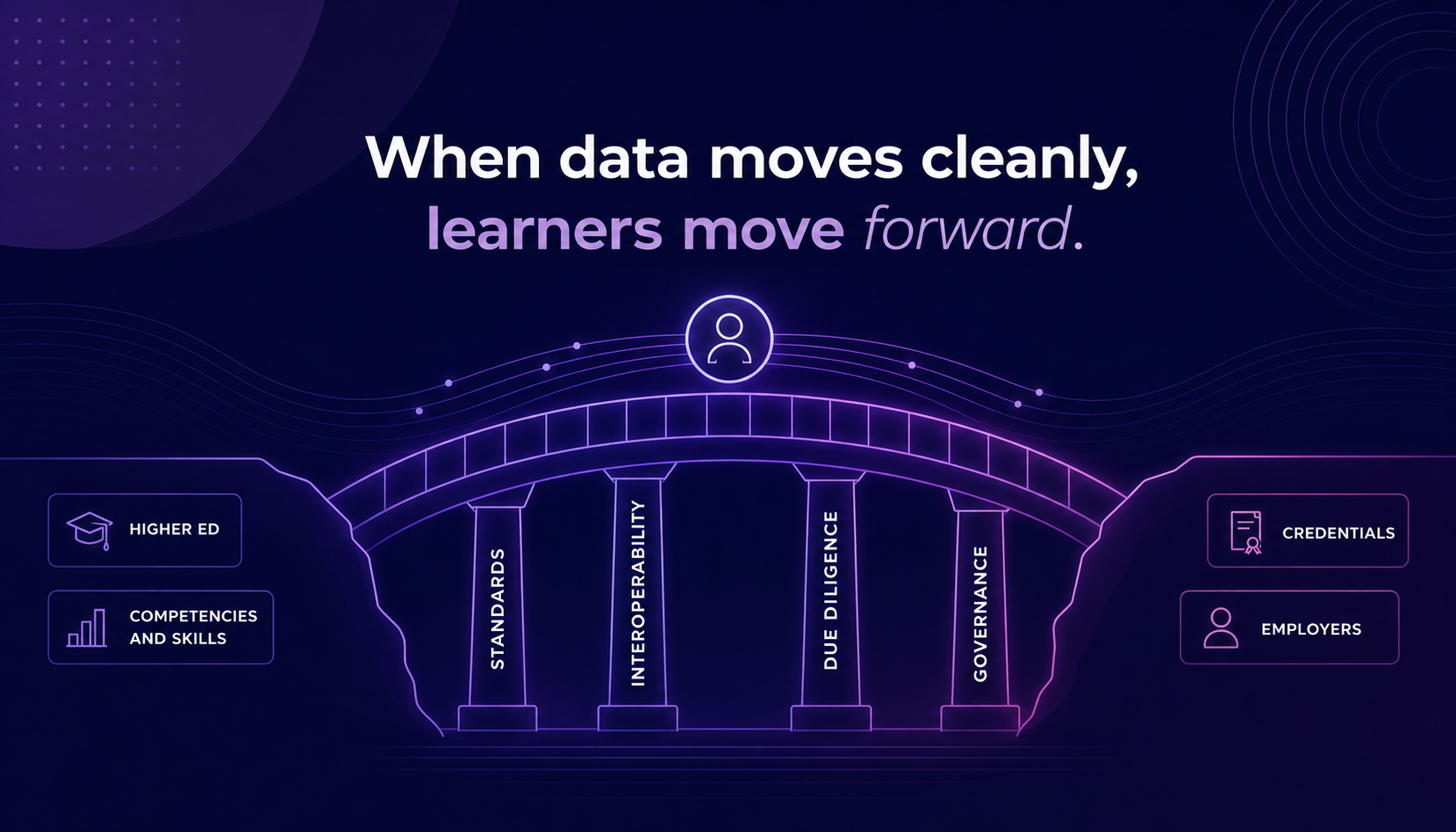
AI has exposed the disconnect between traditional degree programs and the immediate needs of the workforce to the point that a recent New Yorker article explored whether college as we know it will even exist in the very near future. In addition to the educational and experiential differences between learning in school and learning on the job, technical gaps make it difficult for employers to connect degrees to meaningful skills.
Under pressure to fill these gaps, many institutions are turning to a skills-forward approach, including modular, stackable non-degree credentials (NDCs) such as digital certificates, badges, and learning and employment records (LERs). These also tend to be more affordable and faster to complete, reducing systemic barriers to education and jobs.
However, these credentials are often not effectively aligned with the larger education and workforce ecosystem in terms of both learning outcomes and portability. As a result, the “ed-to-workforce” gap is more than a curriculum issue: it is an infrastructure and data mobility problem.
Though instituting a skills-forward model is a good start, many institutions lack the tech layer that proves their students can do what they’ve learned.
“Institutions are often eager to incorporate skills-based programs and curricula that reflect real-world employment demand, but lack the technical agility to incorporate them effectively.” — Kathryn Green, Director, Strategic Project Management & Ecosystem Initiatives at Unicon
Without this foundation in place to ensure interoperable, verifiable digital credentials, even the most effective, up-to-date programs will fail learners and employers.
The Current State of Skills-Based Training in Higher Ed
Traditional degree programs often struggle to keep pace with the speed of AI-driven workforce change, even as institutions may not realize they are falling behind.
A recent report found that more than three-quarters of higher education leaders believe their programs are aligned with employer expectations, but only 28% of employers agree.
That may be driving the growth in NDCs: there are now more than 1.5 million unique offerings in the US. However, many employers are skeptical of credentials lacking validated evidence of mastery (even as nearly two-thirds report using skills-based hiring practices for entry-level employees), often perceiving them as “badges of attendance” rather than proof of expertise.
The unevenly applied education standards, a wide range of uncoordinated models and platforms, and a fragmented technology environment can lead learners and workers to invest in credentials that lack coherent pathways, don’t transfer easily across core systems, or are otherwise of limited use in preparing them for a fast-moving job market.
Add to this a lack of coordination with employers to identify and align with in-demand skills and competencies, and a fragmented technology ecosystem that doesn’t support the interoperability to verify, stack, and share credentials.
Against this backdrop, institutions also risk developing digital credential frameworks that offer little value in the workplace, serving as little more than static merit badges. Without investing in creating this infrastructure first, credentials lack the trust, portability, and relevance necessary for widespread recognition and long-term adoption.
Designing Meaningful, Verifiable Digital Credentials
To effectively prepare learners for an AI-driven work environment, digital credentials must represent rigorous, observable, and validated competencies that are tracked to real-world workforce needs, supporting “verifiable meaning” and trust. But instead of letting the technology lead the effort, institutions must take an intentional, human-led approach to credentials, designing them for proven use cases, aligning with learner and employer needs, and building them to be interoperable with the larger ecosystem.
AI tools in higher education can help map curriculum to skills, but they must be guided and overseen by human judgment, with clear processes to ensure AI does not become a proxy for human expertise. Cross-functional governance led by faculty, advisors, and employers ensures that competencies are consistently rigorous, observable, and validated. Integrating industry frameworks like Open Badges, CASE, and the Comprehensive Learner Record supports digital credentials that are portable, interoperable, and tied to clearly defined skills and competencies, giving employers greater confidence in what learners actually know and can do.
Infrastructure That Enables Mobility
Ultimately, a successful approach to credentialing requires building an infrastructure layer that connects fragmented systems, including student information systems, learning management systems, and employer hiring tools. Beyond implementing and managing technology, this involves foundational technical tasks:
- Due diligence, including assessing capacity, architecture, scalability, technical feasibility, and institutional maturity
- Data strategy and governance to ensure data flows seamlessly and supports decision-making and employer trust
- Integrating interoperability standards like LTI 1.3 and Ed-Fi so skills data is mobile, transferable, and actionable
Unicon builds this infrastructure layer in concert with institutions, technology, and employers by connecting fragmented systems like student information systems, learning management systems, and employer hiring tools — helping stakeholders navigate the complexities of technology, standards, and expectations to build sustainable, skills-aligned digital credentials.
AI’s Impact on Higher Education and the Infrastructure of Trust
While the demand for skills-based training has led to an explosion of innovative offerings, the market needs interoperability driven by standards-aligned infrastructure, not more disconnected badging platforms and credentials. Solving this problem helps institutions meet changing learner and workforce needs and expectations while also expanding alternatives and additions to traditional degrees—presenting a valuable opportunity to build a more equitable, efficient, and transparent system that will ultimately benefit both students and employers. Learners can gain and show mastery in smaller units, while employers experience less risk and uncertainty in recruitment and hiring.
Higher education is in flux as AI continues to be integrated into learning and work. Experimentation and iteration are necessary parts of the journey, but initiatives must always be built on real operational needs, human expertise and guidance, and purposeful planning, not hype.
“AI can be viewed as a ‘digital superpower’ that extends institutional capacity, but it cannot replace institutional judgment. Successful AI initiatives require investing in these less visible foundations as the first step.” — Jason Richter, Ed.D, Director of Project Management at Unicon
In this way, institutions use AI as a catalyst and a tool for transformation instead of letting it dictate priorities, shape strategy, or drive decisions without human input.